Parent guide · with printable checklist
Signs Your Child Needs an Airway Assessment
Most of the signs that a child is not breathing well show up somewhere other than the nose. They show up at bedtime, at breakfast, at school pick-up and in the shape of the face. This guide sets out what to look for, what the research says about each sign, and gives you a checklist to fill in before you speak to anyone.
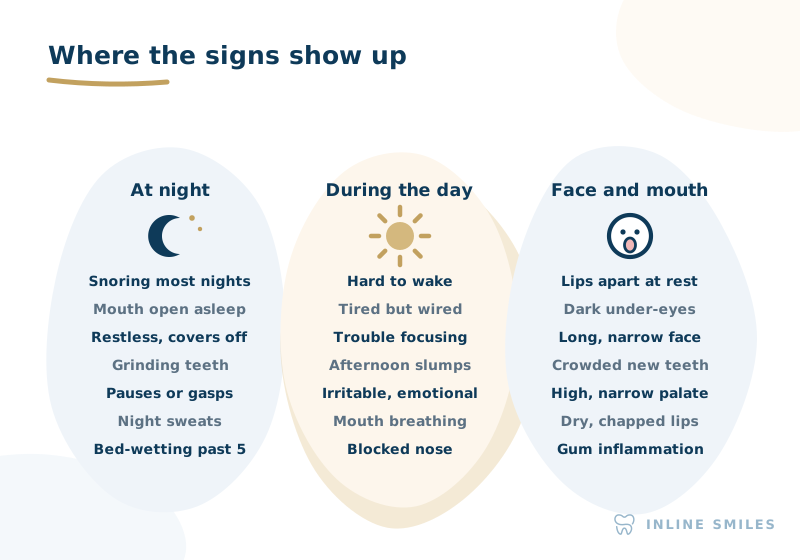
The short answer. Consider an airway assessment if your child snores most nights, sleeps with their mouth open, is restless in bed, wakes unrefreshed, or has crowded teeth with a narrow, high palate. Habitual snoring affects roughly 7 to 10 percent of children and obstructive sleep apnoea around 1 to 4 percent.1 The American Academy of Pediatrics recommends that all children be screened for snoring.2 A dental airway check is a screening step, not a diagnosis; sleep apnoea is diagnosed by a GP or sleep physician.
Why This Gets Missed
Disturbed breathing in children rarely announces itself. A child who is not sleeping properly does not usually say they are tired, and does not usually look tired. Sleep debt in childhood tends to show up as the opposite of sleepiness: restlessness, irritability, difficulty settling and difficulty concentrating.
The result is that families often spend years addressing the symptom that is loudest, usually behaviour or school focus, without anybody asking how the child is breathing at two in the morning. The signs below are grouped by where you would actually notice them, because that is how parents encounter them.
Group one
Signs at Night
- Snoring on most nightsThe single most useful sign. Occasional snoring with a cold is unremarkable; habitual snoring is the entry point to the whole picture and is what the AAP guideline asks clinicians to screen for.2
- Sleeping with the mouth openLook twenty minutes after they fall asleep. Lips apart and audible breathing means the nose is not doing the work.
- Restless sleep and odd positionsCovers thrown off, head hanging back off the pillow, ending the night sideways. Children instinctively find positions that open the airway.
- Pauses, gasps or snortsThe most concerning single observation. Worth raising with your GP promptly rather than waiting for a dental appointment.
- Grinding teethOften assumed to be stress or worms. In children it is frequently reported alongside disturbed breathing.3
- Night sweatsA damp pillow or hair with no fever. The effort of breathing against a partly blocked airway is physical work.
- Bed-wetting continuing past about age fiveLess widely known, but studied: enuresis has been documented in children with sleep apnoea, and improvement after treatment has been reported.4
Group two
Signs During the Day
- Very hard to wakeTwelve hours in bed and still difficult to rouse suggests the hours are not doing their job.
- Tired but wiredThe classic childhood presentation. Hyperactivity and inattention were significantly associated with snoring and other sleep-disordered breathing symptoms in a study of more than 800 children.5
- Emotional volatility, particularly late afternoonMeltdowns that arrive on a schedule are worth noting as a pattern.
- Mouth open at restWatch them watching television. Lips apart when nothing is being asked of them is the resting default that matters.
- A nose that is blocked most weeksNot just during colds. Allergic rhinitis and chronic congestion keep the nose out of action, and mouth breathing in allergic children has been linked with altered dentofacial development.8
Group three
Signs in the Face, Mouth and Teeth
These are the ones a dentist is best placed to spot, and the ones that tend to have been developing quietly for years.
- A high, narrow palateChildren with sleep-disordered breathing have been shown in meta-analysis to have measurably different craniofacial and upper airway morphology, including narrower upper jaws.9
- Crowded adult teeth arrivingOral habits and mouth breathing are associated with malocclusion.3 Crowding is usually a width problem rather than a tooth-size problem.
- A longer, flatter mid-faceMeta-analysis has found mouth-breathing children differ from nose breathers in both vertical and sagittal skeletal measurements.10
- Dark circles under the eyesLong recognised in the clinical literature on recognising mouth-breathing children.11
- Chapped lips and dry front gumsAir running across the front teeth all night dries the tissue and reduces saliva's protective effect.
- An anterior open bite or a crossbiteFront teeth that do not meet, or upper back teeth biting inside the lower, both point toward a width or posture problem.
Why Age Changes the Answer
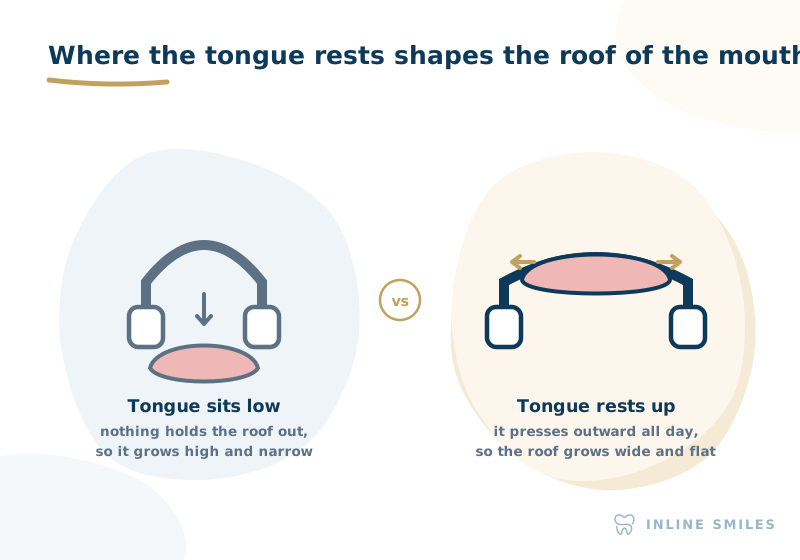
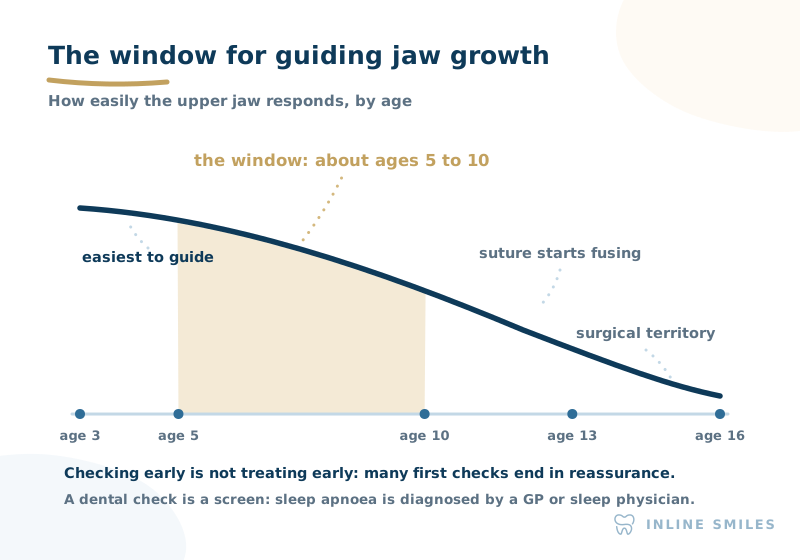
The upper jaw is two halves joined by a suture along the middle of the palate. While that join is open, widening the jaw guides growth that is already happening. As it fuses through the teenage years, the same change becomes a surgical question instead.
The role of oral and facial growth in paediatric sleep-disordered breathing, and the case for addressing it during the growing years, has been set out repeatedly in the literature.12 Where expansion is appropriate, a systematic review and meta-analysis of rapid maxillary expansion in children with obstructive sleep apnoea reported improvements in sleep study measures.13 Other reviews rate this evidence as low certainty and do not support expansion as a stand-alone treatment for sleep apnoea.15
None of that means every child needs treatment. It means the assessment is worth having while the answer can still be "we will watch this".
Take this with you
The Airway Assessment Checklist
Tick anything you have noticed in the last three months. There is no scoring system here and no threshold that means something is definitely wrong. It exists so that when you speak to your GP or dentist you can describe a pattern instead of trying to remember one.
At night
During the day
Face, mouth and teeth
History
What to do with it. If you ticked anything under pauses, gasps or snorts, raise it with your GP rather than waiting. Otherwise, bring the completed list to whichever appointment comes first. Add one thing that costs nothing and helps more than the whole checklist: a thirty second video of your child asleep, face and chest in frame, room quiet, twenty minutes after they drop off.
Who Assesses What
Airway problems in children sit across several professions, and knowing who does what saves a lot of time.
Your GP
First stop for snoring, pauses or suspected sleep apnoea. Coordinates referrals and rules out medical causes.
ENT specialist
Assesses tonsils, adenoids and the nasal airway, and decides whether surgery is warranted.
Sleep physician
Diagnoses sleep disorders, arranges and interprets sleep studies. Diagnosis of sleep apnoea belongs here.
Us
Screening the jaws, palate width, bite and breathing signs. We describe what we find, and refer when it belongs elsewhere.
What we do not do. We do not diagnose sleep apnoea or any other sleep disorder, and we do not diagnose or treat ADHD. Neither is within a dentist's scope, so be cautious of any dental claim to the contrary. What we can do is look at how the jaws have grown, whether there is room, and whether what we see is worth someone else's attention.
Common Questions
At what age should a child have an airway assessment?
Around five is a practical starting point, because adult teeth are beginning to arrive and there is still plenty of growth left to work with. If you are noticing signs earlier, earlier is fine. There is no benefit in waiting for a birthday.
My child snores but seems perfectly happy. Do I still need to do anything?
Habitual snoring is worth mentioning to your GP even in a child who seems fine, because the effects that matter happen during sleep and are not always visible during the day. It may well turn out to be nothing.
Can a dentist diagnose sleep apnoea?
No. Diagnosis requires a sleep study and belongs to a GP or sleep physician. A dentist can screen, describe the jaw and airway anatomy, and refer.
How many signs mean something is wrong?
There is no number. Validated screening questionnaires used in research settings do score symptoms,14 but interpreting them is a clinical task. Treat the checklist as a way of describing a pattern accurately, not as a test with a pass mark.
What actually happens at an airway check with you?
We talk through what you have noticed, look at jaw width, palate shape, bite and how the lips and tongue rest, and explain plainly what we see. Many checks end in reassurance and a note to look again in a year. If something needs medical assessment we write to your GP.
Is it too late if my child is thirteen?
Not too late to assess, and not too late to treat, but the options change. Widening the upper jaw is far simpler while the palatal suture is still open. It is still worth knowing where things stand.
Does an airway check involve X-rays?
Not the free check. That is a conversation and a visual examination. If records or imaging would genuinely add something, we explain why and quote it separately, and you decide.
References
- Lumeng JC, Chervin RD. Epidemiology of pediatric obstructive sleep apnea. Proc Am Thorac Soc. 2008;5(2):242-252.
- Marcus CL, Brooks LJ, Draper KA, et al. Diagnosis and management of childhood obstructive sleep apnea syndrome. Pediatrics. 2012;130(3):e714-e755.
- Grippaudo C, Paolantonio EG, Antonini G, Saulle R, La Torre G, Deli R. Association between oral habits, mouth breathing and malocclusion. Acta Otorhinolaryngol Ital. 2016;36(5):386-394.
- Brooks LJ, Topol HI. Enuresis in children with sleep apnea. J Pediatr. 2003;142(5):515-518.
- Chervin RD, Archbold KH, Dillon JE, et al. Inattention, hyperactivity, and symptoms of sleep-disordered breathing. Pediatrics. 2002;109(3):449-456.
- Gozal D. Sleep-disordered breathing and school performance in children. Pediatrics. 1998;102(3 Pt 1):616-620.
- Bonuck K, Freeman K, Chervin RD, Xu L. Sleep-disordered breathing in a population-based cohort: behavioral outcomes at 4 and 7 years. Pediatrics. 2012;129(4):e857-e865.
- Bresolin D, Shapiro PA, Shapiro GG, Chapko MK, Dassel S. Mouth breathing in allergic children: its relationship to dentofacial development. Am J Orthod. 1983;83(4):334-340.
- Katyal V, Pamula Y, Martin AJ, Daynes CN, Kennedy JD, Sampson WJ. Craniofacial and upper airway morphology in pediatric sleep-disordered breathing: a systematic review and meta-analysis. Am J Orthod Dentofacial Orthop. 2013;143(1):20-30.
- Zhao Z, Zheng L, Huang X, Li C, Liu J, Hu Y. Effects of mouth breathing on facial skeletal development in children: a systematic review and meta-analysis. BMC Oral Health. 2021;21(1):108.
- Pacheco MC, Casagrande CF, Teixeira LP, Finck NS, de Araújo MT. Guidelines proposal for clinical recognition of mouth breathing children. Dental Press J Orthod. 2015;20(4):39-44.
- Huang YS, Guilleminault C. Pediatric obstructive sleep apnea and the critical role of oral-facial growth: evidences. Front Neurol. 2013;3:184.
- Camacho M, Chang ET, Song SA, et al. Rapid maxillary expansion for pediatric obstructive sleep apnea: a systematic review and meta-analysis. Laryngoscope. 2017;127(7):1712-1719.
- Chervin RD, Hedger K, Dillon JE, Pituch KJ. Pediatric Sleep Questionnaire (PSQ): validity and reliability of scales for sleep-disordered breathing, snoring, sleepiness, and behavioral problems. Sleep Med. 2000;1(1):21-32.
- Bucci R, Rongo R, Zunino B, et al. Effect of orthopedic and functional orthodontic treatment in children with obstructive sleep apnea: a systematic review and meta-analysis. Sleep Med Rev. 2023;67:101730.
Related reading: mouth breathing in children, palate expander vs extractions, and our pages on early orthodontics and palatal expansion.
Clinically reviewed by Dr Sofia Monter, general dentist · Reviewed October 2026
This page is general information, not personal advice. It does not replace assessment by a health practitioner who has examined your child. Orthodontic treatment at Inline Smiles is provided by general dentists with additional orthodontic training; where specialist care is in your child's best interest, we will tell you and refer you.
Bring the Checklist In
A free orthodontic and airway check goes through what you have ticked, looks at jaw width, bite and breathing signs, and gives you a plain answer. Many end in reassurance. Appointments are available on Saturdays and Sundays.
Book a free orthodontic & airway checkOne complimentary consultation per person. The free orthodontic and airway consultation includes a discussion of your concerns, a visual examination, general information about suitable options and an approximate plan and quote. It does not include diagnostic records, X-rays, photographs or a formal diagnosis; these are quoted separately if you choose to proceed, and your plan and quote may change if they show anything not visible at the examination. There is no obligation to proceed with any treatment. Orthodontic treatment is provided by general dentists with additional orthodontic training.