Parent guide · 12 minute read
Mouth Breathing in Children: The Effects, and What Helps
Breathing through the mouth instead of the nose is common in childhood, and it is easy to miss because it looks like nothing at all. This guide walks through what it does to the face, the sleep and the day, what the research actually shows, and what can be done while a child is still growing.
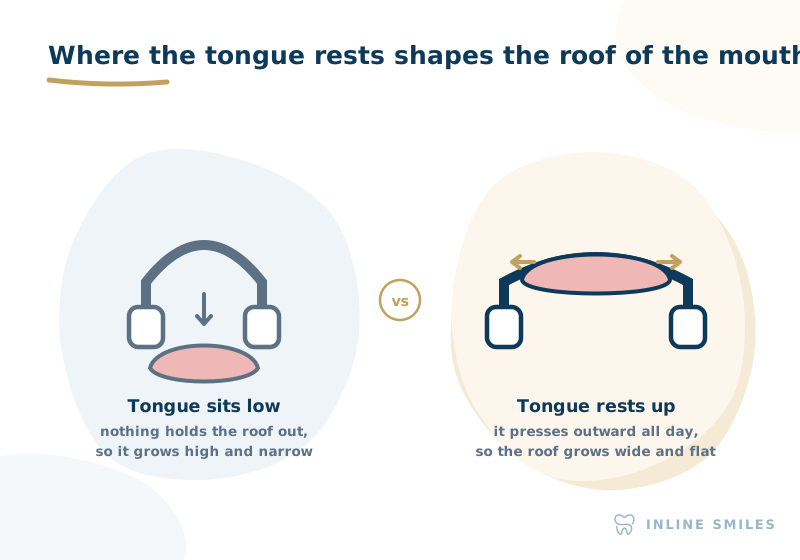
The short answer. Children who breathe through the mouth instead of the nose tend to grow longer, narrower faces with higher, narrower palates and more crowded teeth, and are more likely to have disturbed sleep. A 2021 systematic review of 10 studies found measurable skeletal differences between mouth-breathing and nose-breathing children.1 The changes build gradually over years, which is why the habit is worth noticing early. Mouth breathing is a sign to investigate, not a diagnosis in itself.
Step 1
What Counts as Mouth Breathing?
Every child breathes through their mouth sometimes. Running around, blocked up with a cold, halfway through a laugh. That is normal and it does not matter.
What matters is the resting default. When your child is sitting still watching television, reading, or asleep, are their lips together and is the air going through the nose? If the mouth is habitually open at rest, the body has switched its default, and it is that constant, low-level pattern that shapes things over years.
It is more common than most parents expect. Prevalence studies in school-age children have reported it in a substantial proportion of children screened.2 It is also under-recognised, because an open mouth does not hurt, does not stop a child playing, and does not usually get raised at a routine check-up.
The nose is not simply a second option for getting air in. It filters, warms and humidifies air, and it produces nitric oxide, which is thought to help the lungs take up oxygen efficiently. Bypassing it changes more than the route.
Step 2
Why Does a Child Start Breathing Through Their Mouth?
Children do not choose this. In most cases the nose became hard to breathe through at some point, and the mouth took over as a sensible workaround.
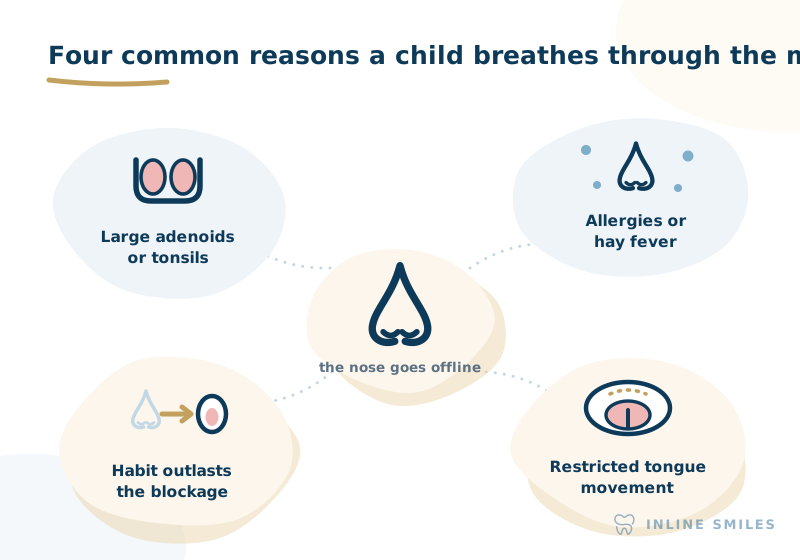
The four usual reasons:
- Enlarged adenoids or tonsilsThe most common physical cause in young children. This tissue peaks in size in the pre-school and early school years, which is exactly when the face is growing fastest.
- Allergies and chronic nasal congestionHay fever, dust mite and pet allergies keep the nasal lining swollen. Mouth breathing in allergic children has been linked with altered dentofacial development since at least the 1980s.3
- A habit that outlasts its causeThis one surprises parents. The adenoids shrink, the allergy is treated, the nose is clear again, and the mouth simply stays open because that is what the muscles learned.
- Restricted tongue movementIf the tongue cannot comfortably reach the roof of the mouth, the lips are harder to keep sealed and the palate loses its natural support.
Step 3
What Mouth Breathing Does to a Growing Face
This is the effect with the most research behind it, and the mechanism is simpler than it sounds.
When a child breathes through the nose with the lips sealed, the tongue rests up against the roof of the mouth. It sits there most of the day and all night, pressing gently outward. The roof of the mouth is also the floor of the nose, and that constant light pressure is one of the forces that encourages the upper jaw to grow wide.
When the mouth is open, the tongue has to drop down and forward to keep the airway clear. The roof of the mouth loses its scaffolding. The cheek muscles keep pressing inward with nothing pushing back. Over years, the upper jaw tends to grow high and narrow instead of wide and flat.
This is not a fringe idea. The principle that resting soft-tissue pressures influence tooth and arch position was formalised in orthodontics decades ago,4 and the specific consequences of mouth breathing have been measured repeatedly since.
The 2021 systematic review and meta-analysis found that, compared with nose-breathing children, mouth-breathing children showed lower SNA and SNB angles, meaning both jaws sat further back, and higher vertical measurements, meaning the face had grown longer and the lower jaw rotated downward and backward.1 Airway measurements were also smaller. An earlier clinical study reported similar dentofacial and craniofacial differences.5
What this means in plain language. A longer face, a less defined jawline, a narrow high palate, and less room for teeth. These are tendencies observed across groups of children, not a prediction about any individual child.
Step 4
What It Does to Sleep
A narrow upper jaw means a narrower nasal floor. Combine that with enlarged tonsils or adenoids and the airway a child has to breathe through overnight gets smaller.
Children with sleep-disordered breathing have been shown to have measurably different craniofacial and upper airway shapes, including narrower upper jaws. A systematic review and meta-analysis found this association consistently across studies.6
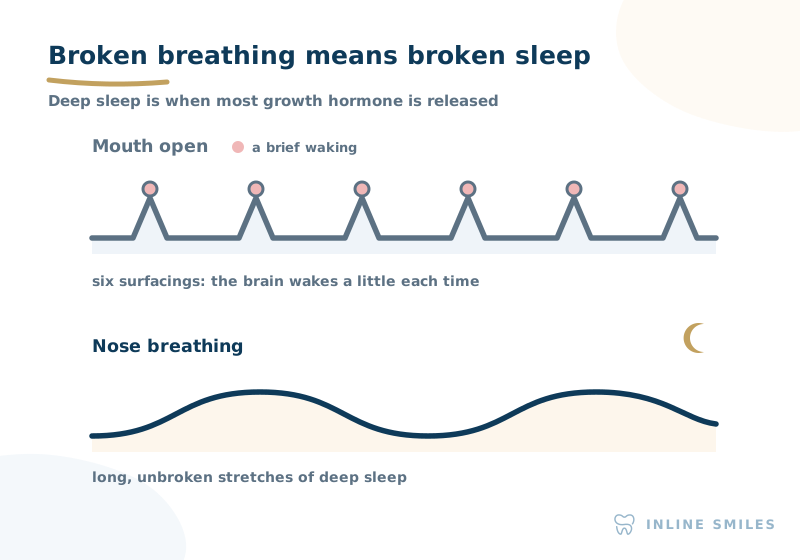
The result is not usually dramatic. Most children do not stop breathing. What happens is subtler: the effort of breathing rises, the brain surfaces briefly out of deep sleep to fix it, and settles again. This can repeat many times a night without the child ever properly waking or remembering a thing.
Deep sleep is when most growth hormone is released, and when the day's learning is consolidated. Fragmenting it has consequences even when total hours in bed look perfectly normal, which is why a parent can honestly say "she sleeps twelve hours" and still be dealing with poor sleep.
Step 5
What It Does to Days: Behaviour, Focus and Energy
This is where parents usually feel it first, long before anyone mentions breathing.
Tired adults get sleepy. Tired children often get the opposite. They get wired, restless, emotionally short-fused and hard to settle. It looks like a behaviour problem rather than a sleep problem, which is exactly why the connection gets missed.
The research here is substantial. A landmark study of over 800 children found that snoring and other symptoms of sleep-disordered breathing were significantly associated with inattention and hyperactivity.7 A population-based cohort following children to ages 4 and 7 found that sleep-disordered breathing symptoms in the pre-school years predicted later behavioural difficulties.8 Earlier work linked sleep-disordered breathing with school performance.9 The American Academy of Pediatrics clinical practice guideline recognises neurobehavioural problems, and effects on growth, among the consequences of untreated childhood obstructive sleep apnoea.10
An important boundary. Poor sleep from disturbed breathing can look like ADHD. That does not mean it is ADHD, and it does not mean children diagnosed with ADHD are simply tired. Both exist, they can occur together, and telling them apart is a job for your GP or paediatrician. We do not diagnose or treat ADHD, and we do not diagnose sleep disorders. What we can do is look at the breathing and the jaws, and say plainly whether we see something worth investigating.
Step 6
What It Does to Teeth and Gums
A narrow upper jaw has less arch length. Adult teeth are wider than the baby teeth they replace, so when they arrive into a jaw that did not widen as it might have, they overlap. Crowding is often the first thing a parent notices, and it arrives years after the cause.
Oral habits and mouth breathing have been shown to be associated with malocclusion in school-age children,11 and open-mouth posture is commonly linked with an anterior open bite and a crossbite, where the upper arch is too narrow to sit outside the lower.
There is also a direct effect on the mouth itself. Air moving constantly across the front teeth and gums dries them out. Saliva is the mouth's own defence system, and a mouth that runs dry for hours every night loses some of that protection, which is why the front gums of habitual mouth breathers are often puffier and redder than the rest.
Step 7
What Parents Can Notice at Home
None of these confirm anything by themselves. Several together are worth a conversation.
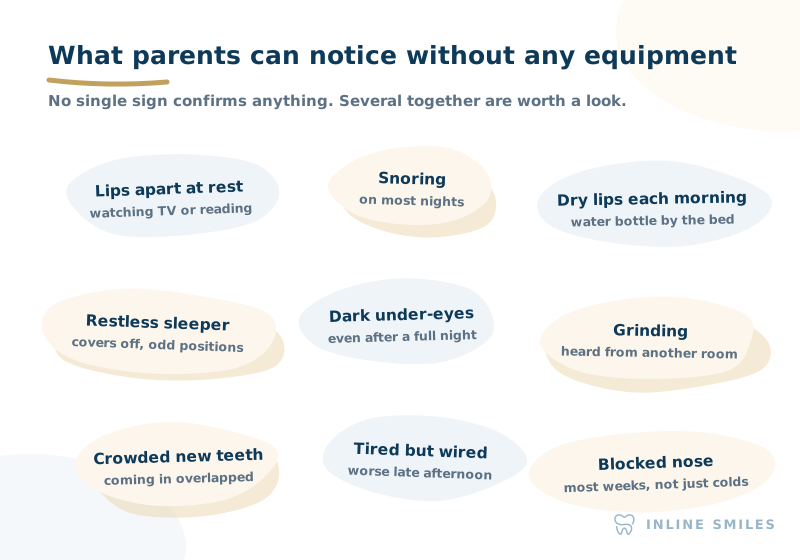
The single most useful thing you can do costs nothing: take a short video of your child asleep, thirty seconds is plenty, twenty minutes or so after they drop off. Get the face and the chest in frame with the room quiet. Parents are often surprised by what they hear back, and it tells a clinician more in half a minute than a page of description.
Step 8
What Actually Helps
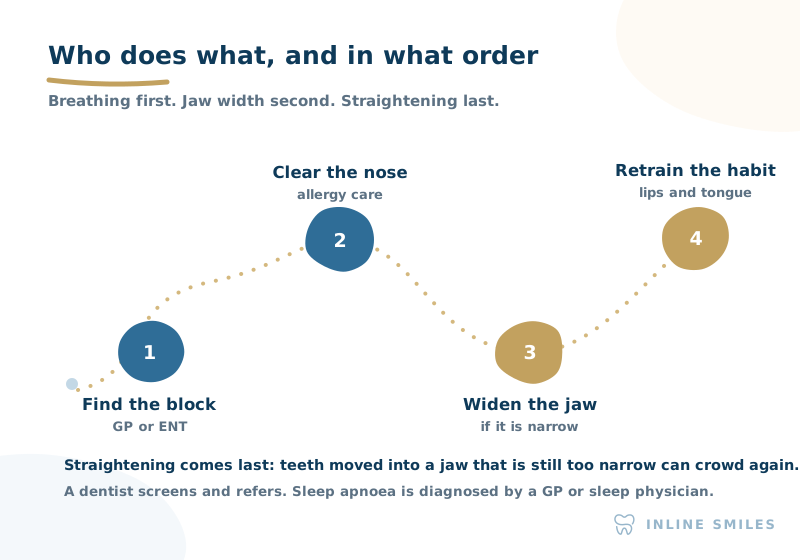
The order matters more than any single step. Working on the teeth while the nose is still blocked tends to give back the same problem in a few years.
- Find out why the nose is blockedThis is medical, not dental. Your GP can assess and refer to an ENT specialist if adenoids or tonsils look like the issue.
- Treat the congestionAllergy management, or removal of obstructing tissue where that is genuinely indicated. The nose has to be usable before anything else works.
- Widen a narrow upper jaw, if it is narrowExpansion during growth increases arch width. A systematic review and meta-analysis of rapid maxillary expansion in children with obstructive sleep apnoea reported improvements in sleep study measures.12 Other reviews rate this evidence as low certainty and do not support expansion as a stand-alone treatment for sleep apnoea.14 Whether it suits an individual child is a clinical judgement, not a given.
- Retrain the habitLip and tongue exercises help re-establish a nose-breathing default once the airway allows it. Without this step the old pattern often returns.
Step 9
Why Age Matters So Much Here
The upper jaw is formed of two halves joined by a suture down the middle of the palate. In young children that join is still open, so widening the jaw is a matter of gently guiding growth. As a child moves through the teens the suture progressively fuses, and after that widening the upper jaw is a surgical question rather than a growth one.
That is the whole reason for the emphasis on early assessment. The research literature on paediatric sleep-disordered breathing has repeatedly highlighted the role of oral and facial growth, and the value of addressing it during the growing years.13
Checking early is not the same as treating early. Many first assessments in five to seven year olds end with reassurance and a note to look again in twelve months. Looking early keeps options open; it does not commit you to anything.
Common Questions
Is mouth breathing actually harmful, or is this overstated?
The association between habitual mouth breathing and altered facial growth is well supported, including by systematic review.1 What is harder to state precisely is how much any individual child will be affected, because the studies describe group differences and children vary enormously. It is reasonable to take it seriously and unreasonable to panic about it.
My child only breathes through their mouth when they have a cold. Is that a problem?
No. Temporary mouth breathing during an illness is normal and expected. The concern is the resting default over months and years, not what happens during a winter cold.
Can the face changes be reversed?
Growth already completed cannot be undone. What can change is the direction of growth still to come, which is why the timing question matters so much. Nobody can promise a particular facial outcome, and you should be cautious of anyone who does.
Does my child need their tonsils out?
That is a decision for your GP and an ENT specialist, not a dentist. Some children clearly benefit; many do not need it. We can tell you what we observe about the jaws and the bite, and write to your GP if we think an airway assessment is warranted.
Is snoring in a child normal?
Occasional snoring with a cold is common. Snoring most nights is worth investigating. The AAP guideline recommends that children be screened for snoring as a routine matter.10
What age should we look at this?
Around five is a practical starting point, because the first adult molars and incisors are arriving and there is still plenty of growth ahead. If you are seeing signs earlier than that, earlier is fine.
Will taping my child's mouth shut at night fix it?
Please do not do this without medical advice. If a child is breathing through their mouth because their nose is genuinely blocked, closing the mouth removes the airway they are relying on. The nose needs to be assessed and usable first.
Do you diagnose sleep apnoea?
No. Diagnosis of sleep apnoea requires a sleep study and belongs to your GP or a sleep physician. We screen, we describe what we see in the jaws, bite and airway space, and we refer.
References
- Zhao Z, Zheng L, Huang X, Li C, Liu J, Hu Y. Effects of mouth breathing on facial skeletal development in children: a systematic review and meta-analysis. BMC Oral Health. 2021;21(1):108.
- Abreu RR, Rocha RL, Lamounier JA, Guerra AF. Prevalence of mouth breathing among children. J Pediatr (Rio J). 2008;84(5):467-470.
- Bresolin D, Shapiro PA, Shapiro GG, Chapko MK, Dassel S. Mouth breathing in allergic children: its relationship to dentofacial development. Am J Orthod. 1983;83(4):334-340.
- Proffit WR. Equilibrium theory revisited: factors influencing position of the teeth. Angle Orthod. 1978;48(3):175-186.
- Harari D, Redlich M, Miri S, Hamud T, Gross M. The effect of mouth breathing versus nasal breathing on dentofacial and craniofacial development in orthodontic patients. Laryngoscope. 2010;120(10):2089-2093.
- Katyal V, Pamula Y, Martin AJ, Daynes CN, Kennedy JD, Sampson WJ. Craniofacial and upper airway morphology in pediatric sleep-disordered breathing: a systematic review and meta-analysis. Am J Orthod Dentofacial Orthop. 2013;143(1):20-30.
- Chervin RD, Archbold KH, Dillon JE, et al. Inattention, hyperactivity, and symptoms of sleep-disordered breathing. Pediatrics. 2002;109(3):449-456.
- Bonuck K, Freeman K, Chervin RD, Xu L. Sleep-disordered breathing in a population-based cohort: behavioral outcomes at 4 and 7 years. Pediatrics. 2012;129(4):e857-e865.
- Gozal D. Sleep-disordered breathing and school performance in children. Pediatrics. 1998;102(3 Pt 1):616-620.
- Marcus CL, Brooks LJ, Draper KA, et al. Diagnosis and management of childhood obstructive sleep apnea syndrome. Pediatrics. 2012;130(3):e714-e755.
- Grippaudo C, Paolantonio EG, Antonini G, Saulle R, La Torre G, Deli R. Association between oral habits, mouth breathing and malocclusion. Acta Otorhinolaryngol Ital. 2016;36(5):386-394.
- Camacho M, Chang ET, Song SA, et al. Rapid maxillary expansion for pediatric obstructive sleep apnea: a systematic review and meta-analysis. Laryngoscope. 2017;127(7):1712-1719.
- Huang YS, Guilleminault C. Pediatric obstructive sleep apnea and the critical role of oral-facial growth: evidences. Front Neurol. 2013;3:184.
- Bucci R, Rongo R, Zunino B, et al. Effect of orthopedic and functional orthodontic treatment in children with obstructive sleep apnea: a systematic review and meta-analysis. Sleep Med Rev. 2023;67:101730.
Related reading: signs your child needs an airway assessment (with a printable checklist), palate expander vs extractions, and how we approach early orthodontics and airway-focused care.
Clinically reviewed by Dr Sofia Monter, general dentist · Reviewed October 2026
This page is general information, not personal advice. It does not replace assessment by a health practitioner who has examined your child. Orthodontic treatment at Inline Smiles is provided by general dentists with additional orthodontic training; where specialist care is in your child's best interest, we will tell you and refer you.
Not Sure Whether Any of This Applies?
A free orthodontic and airway check looks at jaw width, bite and breathing signs, and tells you plainly whether there is anything worth acting on. Many end in reassurance. Appointments are available on Saturdays and Sundays.
Book a free orthodontic & airway checkOne complimentary consultation per person. The free orthodontic and airway consultation includes a discussion of your concerns, a visual examination, general information about suitable options and an approximate plan and quote. It does not include diagnostic records, X-rays, photographs or a formal diagnosis; these are quoted separately if you choose to proceed, and your plan and quote may change if they show anything not visible at the examination. There is no obligation to proceed with any treatment. Orthodontic treatment is provided by general dentists with additional orthodontic training.