Parent guide · 11 minute read
Palate Expander vs Extractions: How the Choice Is Actually Made
Crowding is a space problem, and there are only two ways to solve a space problem: make the arch bigger, or make the contents smaller. This guide explains what each route does, how much room each one creates, when each is genuinely the right answer, and which popular arguments about extractions the evidence does not support.
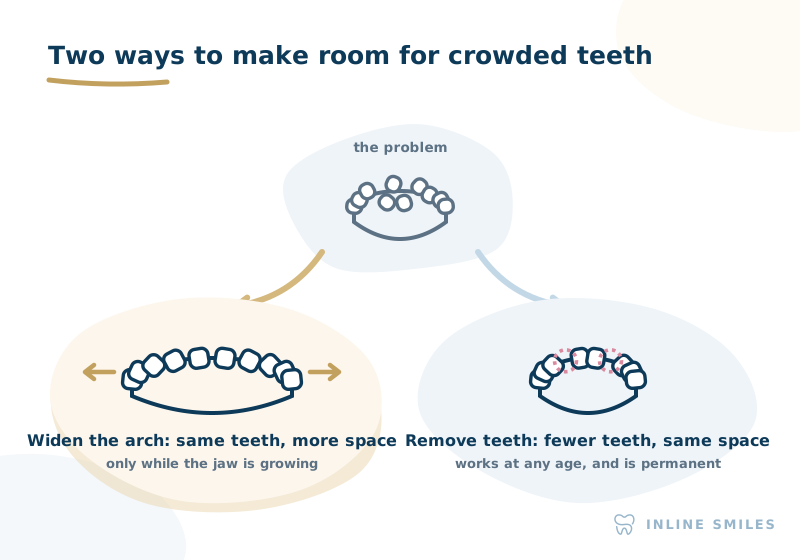
The short answer. A palate expander widens the upper jaw while a child is still growing, creating roughly 0.7 mm of arch space for every 1 mm of widening.1 Removing two upper premolars creates far more space, around 14 mm, and works at any age but cannot be reversed. Expansion is only an option while the palatal suture is open, which is why the choice is age-dependent. Neither is universally better: mild to moderate crowding with a narrow arch usually suits expansion, while severe crowding or significant protrusion may genuinely need extractions.
Why Crowding Happens in the First Place
Adult teeth are wider than the baby teeth they replace. Nature's plan is that the jaw grows to accommodate them, which is why gaps between baby teeth are a good sign rather than a problem.
When the upper jaw does not reach its full width, the teeth arrive into an arch that is short of perimeter and they overlap. Several things can limit that growth, and habitual mouth breathing is one that has been studied extensively: meta-analysis has found measurable skeletal differences between mouth-breathing and nose-breathing children, including in the transverse dimension.2 Oral habits and mouth breathing are also associated with malocclusion.3
This matters for the decision at hand, because if crowding is a symptom of a jaw that did not widen, then widening the jaw addresses the cause. If crowding is genuinely a tooth-size-to-jaw-size mismatch in a jaw of normal width, it does not.
What a Palate Expander Does
The upper jaw is formed from two halves joined along a suture that runs front to back down the middle of the palate. In children that join has not yet fused. An expander applies gentle outward pressure across it, and the two halves separate very slightly. New bone fills the gap.
The result is a physically wider upper jaw. Because the roof of the mouth is also the floor of the nose, widening it increases nasal floor width at the same time, which is why expansion appears in the sleep literature as well as the orthodontic one. A systematic review and meta-analysis of rapid maxillary expansion in children with obstructive sleep apnoea reported improvements in sleep study measures.4 Other reviews rate this evidence as low certainty and do not support expansion as a stand-alone treatment for sleep apnoea.8
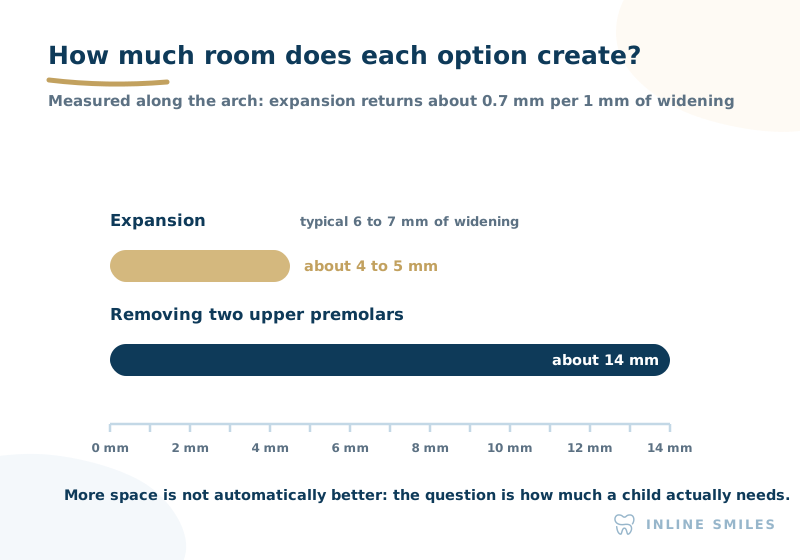
The space gained is modest and predictable. Classic research measured arch perimeter change against expansion and found roughly 0.7 mm of perimeter for every 1 mm of posterior width gained.1 A typical 6 to 7 mm expansion therefore returns something in the order of 4 to 5 mm of room.
The catch is timing. As the suture fuses through adolescence, the same appliance stops separating bone and starts simply tipping teeth outward. In adults, genuine skeletal widening becomes a surgical procedure.
What Extractions Do
Removing teeth, usually two or four premolars, creates space directly. Each upper premolar is roughly 7 mm wide, so taking two out frees about 14 mm in the upper arch. That is around three times what a typical expansion delivers.
That space is then used to line up the remaining teeth, and in cases of significant protrusion, to pull the front teeth back. Extraction treatment is a long-established, well-understood approach with a large evidence base, and for some presentations it is clearly the right answer.
Its two defining features are that it works regardless of age, and that it is permanent. Neither is a criticism. They are simply the facts that shape when it should be chosen.
When Extractions Are Genuinely the Right Call
Our approach is to try to make room before removing teeth, and we say so plainly. That is not the same as claiming extractions are always wrong, and you should be cautious of any claim that extractions are never needed.
Extractions are often the appropriate choice when:
- Crowding is severeWhere a case is short 10 mm or more of space, expansion alone cannot bridge that gap. The arithmetic does not work.
- The front teeth protrude significantlyWidening the arch does not retract front teeth. Where the profile genuinely needs the front teeth brought back, space has to come from somewhere.
- Growth has finishedIn an adult, skeletal expansion is a surgical question. For many adults, extraction is the less invasive of the two options.
- The arch is already a normal widthIf the jaw is not narrow, widening it further is not treating anything and risks pushing teeth beyond their supporting bone.
The honest framing. Expansion is not a way of avoiding extractions in every case. It is a way of finding out whether extractions are actually necessary, at an age when there is still a choice. Sometimes the answer is that they are.
The Facial Profile Argument, and What the Evidence Shows
You will find a great deal of material online claiming that premolar extractions cause flattened, "dished-in" faces and damaged airways. It is worth being straight about this, because it is one of the most contested topics in orthodontics and the popular version overstates the case.
Studies comparing extraction and non-extraction treatment have generally found the differences in soft tissue profile to be small, and much smaller than the online debate implies. Reviews of the evidence on extraction and the airway have similarly not established the clear harm that is often asserted.
What can be said with more confidence is narrower and more useful:
- A narrow upper jaw is associated with disturbed breathing in childrenMeta-analysis has found children with sleep-disordered breathing differ in craniofacial and upper airway morphology, including narrower maxillae.5
- Widening a narrow jaw can help those childrenDemonstrated in the expansion and sleep apnoea literature.4
- That is an argument for assessing width earlyIt is not, by itself, proof that extraction harms an airway that was never narrow to begin with.
We prefer to make room where we reasonably can, and the reason is straightforward: teeth you keep are options you keep. That is a defensible clinical preference. It is not a claim that the alternative causes harm, and we are not going to tell you it is.
Will It Stay Straight Either Way?
Relapse is the honest weak point of both approaches, and it is worth understanding before you choose anything.
Long-term follow-up studies of orthodontic patients ten and twenty years after retention ended found that lower front tooth alignment tended to deteriorate over time in a substantial proportion of cases, regardless of whether teeth had been extracted.6 Some crowding returning is common, not a sign that something went wrong.
Expansion has its own stability question. Systematic review of long-term dental arch changes after rapid maxillary expansion has found that some of the width gained is lost over time.7 This is why retention matters, and why anyone promising a permanent result from any orthodontic treatment is overselling.
The practical implication is the same for both routes: plan for retainers, and expect to keep them.
How the Decision Gets Made
Measure the shortfall
How many millimetres of space is the arch actually short? This is measured, not estimated by eye.
Check the width
Is the upper jaw genuinely narrow, or normal width with large teeth? These lead to different answers.
Check the profile and airway
Do the front teeth need retracting? Are there breathing signs pointing to a transverse problem?
Check the age
Is the suture still open? This determines whether expansion is even on the table.
What we do. Where a jaw is narrow and a child is still growing, we will usually try to create room before considering removing teeth, and we will show you the measurements behind that view. Where the arithmetic says expansion cannot solve it, we will say so. Where specialist care is in your child's best interest, we will tell you and refer you.
Common Questions
Does a palate expander hurt?
Most children feel pressure or soreness, strongest for a few minutes after each turn and in the first few days. Discomfort is usually managed with ordinary pain relief. A gap often opens between the front teeth during expansion, which is a sign it is working, and it usually closes on its own.
How long does an expander stay in?
Active widening typically takes a few weeks. The appliance then stays in place for several months while new bone fills and stabilises the join. Removing it too early is the main cause of losing the width gained.
What is the best age for an expander?
Broadly between about seven and eleven, while the palatal suture is clearly open, though it depends on the individual child rather than the birthday. After the mid-teens, skeletal expansion generally requires surgical assistance.
Can adults have a palate expander instead of extractions?
Conventional expanders in adults tend to tip teeth rather than widen bone. Genuine skeletal expansion in adults involves surgical or bone-anchored techniques. For many adults, extraction is the less invasive option, which is a reversal of the usual position in children.
If we expand now, are extractions off the table forever?
No, and it would be misleading to suggest otherwise. Expansion creates a few millimetres and can reduce the likelihood that extractions will be needed. In a severely crowded case it may not be enough on its own, and that should be discussed openly at the start rather than discovered later.
Is expansion more expensive than extractions?
Costs vary with the individual case and neither is reliably cheaper. Expansion adds an appliance phase; extractions add a surgical procedure and often a longer alignment phase. We quote both in writing before anything begins.
Will my child need braces afterwards either way?
Usually yes. Expansion creates space; it does not straighten teeth. Extractions create space; they do not straighten teeth either. Both are normally followed by an alignment phase.
Are you specialist orthodontists?
No. Orthodontic treatment at Inline Smiles is provided by our experienced general dentists with additional orthodontic training. Where specialist care is in your child's best interest, we will tell you and refer you.
References
- Adkins MD, Nanda RS, Currier GF. Arch perimeter changes on rapid palatal expansion. Am J Orthod Dentofacial Orthop. 1990;97(3):194-199.
- Zhao Z, Zheng L, Huang X, Li C, Liu J, Hu Y. Effects of mouth breathing on facial skeletal development in children: a systematic review and meta-analysis. BMC Oral Health. 2021;21(1):108.
- Grippaudo C, Paolantonio EG, Antonini G, Saulle R, La Torre G, Deli R. Association between oral habits, mouth breathing and malocclusion. Acta Otorhinolaryngol Ital. 2016;36(5):386-394.
- Camacho M, Chang ET, Song SA, et al. Rapid maxillary expansion for pediatric obstructive sleep apnea: a systematic review and meta-analysis. Laryngoscope. 2017;127(7):1712-1719.
- Katyal V, Pamula Y, Martin AJ, Daynes CN, Kennedy JD, Sampson WJ. Craniofacial and upper airway morphology in pediatric sleep-disordered breathing: a systematic review and meta-analysis. Am J Orthod Dentofacial Orthop. 2013;143(1):20-30.
- Little RM, Riedel RA, Årtun J. An evaluation of changes in mandibular anterior alignment from 10 to 20 years postretention. Am J Orthod Dentofacial Orthop. 1988;93(5):423-428.
- Lagravère MO, Major PW, Flores-Mir C. Long-term dental arch changes after rapid maxillary expansion treatment: a systematic review. Angle Orthod. 2005;75(2):155-161.
- Bucci R, Rongo R, Zunino B, et al. Effect of orthopedic and functional orthodontic treatment in children with obstructive sleep apnea: a systematic review and meta-analysis. Sleep Med Rev. 2023;67:101730.
Related reading: mouth breathing in children, signs your child needs an airway assessment, and our pages on palatal expansion, braces and early orthodontics.
Clinically reviewed by Dr Sofia Monter, general dentist · Reviewed October 2026
This page is general information, not personal advice. It does not replace assessment by a health practitioner who has examined your child. Orthodontic treatment at Inline Smiles is provided by general dentists with additional orthodontic training; where specialist care is in your child's best interest, we will tell you and refer you.
Find Out Which One Your Child Is Actually Facing
A free orthodontic and airway check measures jaw width and the space shortfall, and gives you a plain answer about whether making room is realistic. Many checks in younger children end in reassurance. Appointments are available on Saturdays and Sundays.
Book a free orthodontic & airway checkOne complimentary consultation per person. The free orthodontic and airway consultation includes a discussion of your concerns, a visual examination, general information about suitable options and an approximate plan and quote. It does not include diagnostic records, X-rays, photographs or a formal diagnosis; these are quoted separately if you choose to proceed, and your plan and quote may change if they show anything not visible at the examination. There is no obligation to proceed with any treatment. Orthodontic treatment is provided by general dentists with additional orthodontic training.